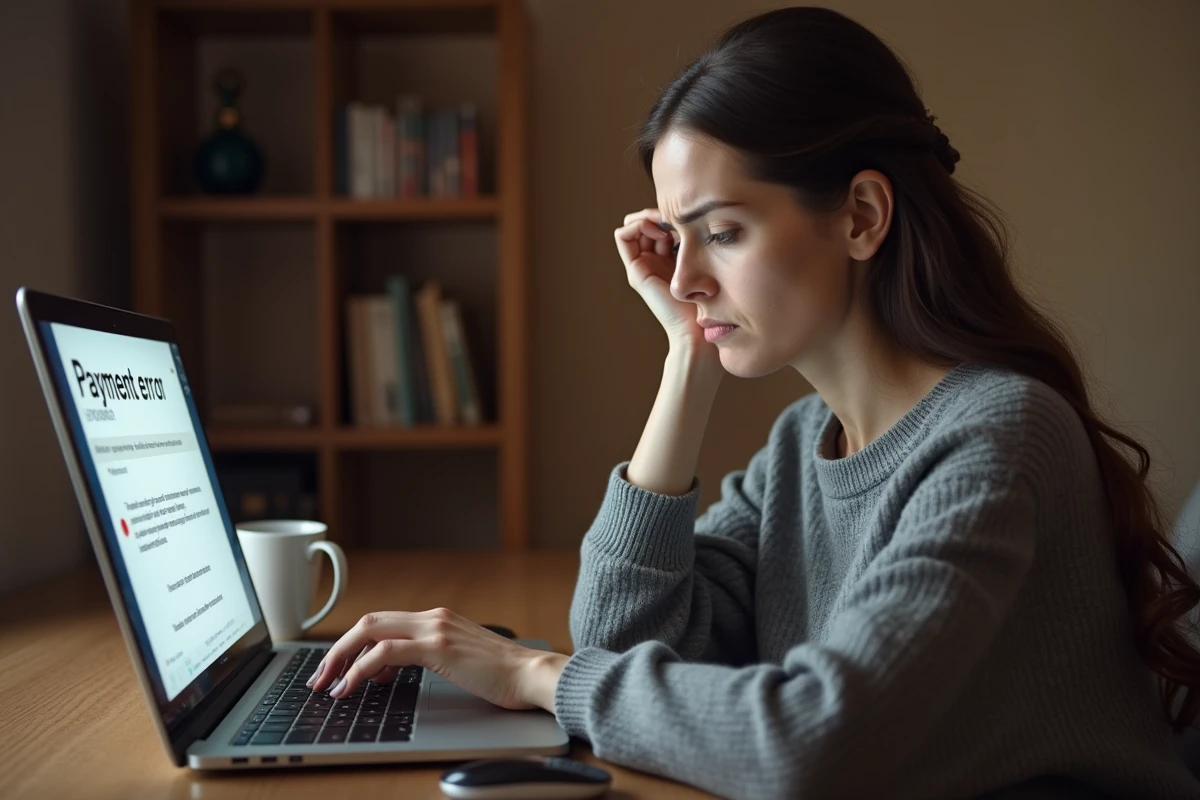
When trying to settle an invoice or pay a subscription, PayPal displays a refusal without a clear explanation. The usual reflex is to retry, sometimes three or four times, which worsens the situation by triggering security alerts on the account. Understanding why a PayPal payment is declined, and especially acting in the right place, helps avoid wasting time and further blocking the account.
PayPal Refusal and International Freelancers: A Customer Retention Issue
Classic tutorials treat PayPal payment refusals as a one-off incident. In practice, for a freelancer invoicing clients in several countries, a recurring refusal can result in losing a contract. The client receives a failure notification, doubts the provider’s reliability, and ends up paying someone else.
The problem arises on two levels. First, PayPal’s anti-fraud filters react to transactions between different currencies, especially when the freelancer frequently changes location. Secondly, a residual negative balance (sometimes related to a refund or an old dispute) silently blocks incoming payments without explicit notification.
When working with a regular client, it is difficult to explain that the payment failed “because of PayPal.” For those facing this type of blockage, the guide on why it is impossible to pay with PayPal on Tech Mafia details several concrete scenarios. The most reliable workaround remains to check the account before each significant invoicing: balance, primary payment method, and verification status.
Card Refusal on PayPal: Technical Causes to Check First
The majority of refusals stem from an issue between PayPal and the associated credit card. It is not always a lack of funds.
- Expired card: PayPal does not always automatically update card details, even if the bank has issued a renewal. The old card must be deleted and the new one registered manually.
- Online payment limit reached: many banks apply a separate limit for internet transactions. One might have reached it unknowingly with another purchase on the same day.
- Block by the issuing bank: some banks block payments to foreign platforms by default. Since PayPal is based in Luxembourg for Europe, the transaction may be classified as “international” by the banking institution.
- Strong authentication not validated: since the implementation of the DSP2 directive, most payments require validation via the banking app. If the push notification does not arrive or expires, the payment is rejected.
The first useful reflex: check the client area of the bank. The reason for refusal often appears there even before PayPal displays an error message.
Negative Balance and PayPal Disputes: The Invisible Block
A common and poorly documented case concerns the negative PayPal balance. When a buyer opens a claim or a refund is issued while the account balance is zero, PayPal puts the account into negative. As long as this debt is not resolved, any new payment is declined.
The catch is that this information does not always appear visibly. One must go to “Wallet” and then check the exact balance. An amount of a few euros in negative is enough to block all outgoing transactions.
Claim Opened by a Buyer
When a dispute is ongoing, PayPal sometimes freezes the associated funds and restricts certain account functionalities. An unresolved dispute for more than twenty days can lead to a complete account block, not just the transaction in question. This is especially noticeable on business accounts that handle a regular volume of transactions.
To unblock the situation, one must respond to the dispute in the resolution center, provide the requested documentation, and wait for the decision. Ignoring a claim is the worst option: PayPal automatically rules in favor of the buyer after the allotted time.
VPN and IP Location: Why PayPal Refuses a Legitimate Payment
Since the end of 2025, PayPal has integrated a more refined dynamic IP detection, which has reduced false positives related to commercial VPNs. However, feedback on the official PayPal Community forum (thread updated in April 2026) indicates that free VPNs continue to trigger systematic refusals.
The mechanism is simple: when the connection IP address does not match the country of the account, PayPal considers the transaction suspicious. If one connects from a VPN server shared by thousands of users, the IP may already be flagged for fraudulent activity.
The Concrete Solution
Disable the VPN before confirming a payment. If one needs a VPN for other reasons (corporate network, public Wi-Fi), switch to mobile connection in 4G/5G during the transaction. Feedback varies on this point depending on the operators, but direct cellular connection rarely poses a problem for PayPal.
Strong Authentication and PayPal Business Accounts: Mandatory Update
Since January 2026, the FTC has imposed a requirement for biometric two-factor authentication for PayPal business accounts in the United States. This measure has caused a wave of rejections among users who had not updated their verification method.
In Europe, the DSP2 directive already mandates strong authentication, but accounts created before its implementation sometimes retain outdated settings. The typical symptom: the payment is declined without any validation request (SMS, fingerprint, code) appearing on the phone.
To correct this, one must access the security settings of the PayPal account, enable two-step verification if it is not already enabled, and ensure that the registered phone number is correct. On a business account, also check that the primary administrator has validated the new security requirements.
A declined PayPal payment almost always has an identifiable cause in the account settings or those of the associated bank. Before contacting customer service, checking the balance, the registered card, the status of ongoing disputes, and the security configuration covers the vast majority of situations. For freelancers invoicing internationally, this verification before each invoice submission becomes a professional reflex as much as a technical one.