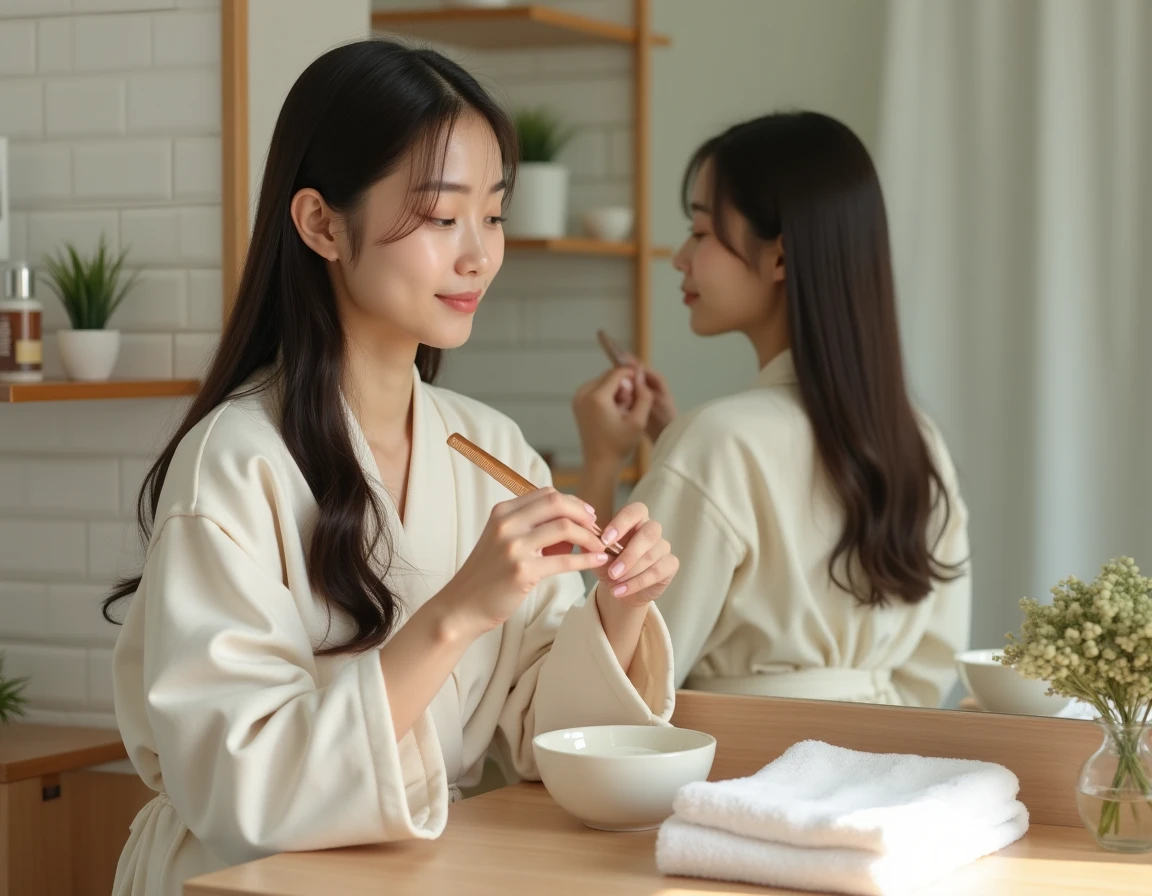
Korean hair owes its neat appearance less to ancestral recipes than to a cosmetic industry organized around hair diagnostics, R&D in formulation, and a continuum between salon and home. Understanding this mechanism allows for the adaptation of products and practices to a French context, where the hair care offering remains structured differently.
Korean Hair Industry: R&D That Structures the Market
South Korea has built a cosmetic ecosystem where hair care receives the same level of investment as skincare. Brands develop ranges segmented by scalp type, hair porosity, and level of chemical damage.
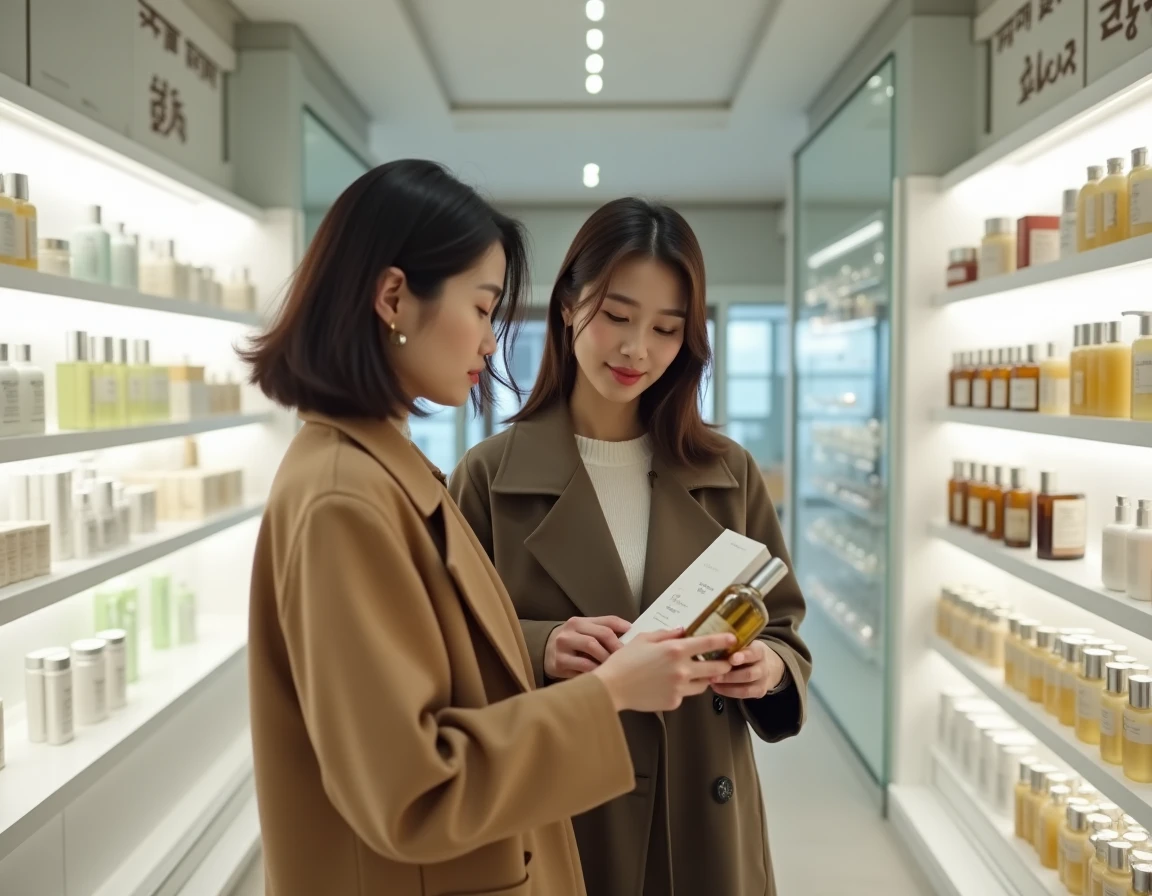
This segmentation relies on diagnostic tools offered in salons, which are then extended at home via applications or questionnaires integrated into sales platforms like Olive Young or Coupang. The result: a Korean consumer rarely chooses a shampoo at random.
To delve deeper into the secrets of Korean hair, one must first understand that this approach stems from a calibrated industrial system, not a ritual passed down through generations.
Following restrictions from the MFDS (the South Korean health authority) on certain silicones and preservatives in rinse-off products between 2020 and 2023, brands have accelerated the shift towards “low damage” or zero silicone formulas. These reformulations prioritize conditioning polymers and local plant oils: Jeju camellia, perilla, rice bran.
“Low Damage” Formulas and Korean Plant Oils: What Changes Practically
The term “low damage” refers to formulations designed to minimize the alteration of the hair fiber with each wash. In practice, this translates to replacing traditional film-forming agents (dimethicone, cyclomethicone) with active ingredients that condition without leaving residues.
Three ingredients appear in the majority of recent Korean ranges:
- Jeju Camellia Oil: Rich in oleic acid, it penetrates the fiber without weighing it down, making it suitable for fine or oily hair.
- Perilla Oil: Less known in Europe, it provides omega-3 fatty acids that enhance the flexibility of hair weakened by heat or coloring.
- Rice Bran: Used in oil or fermented extract form, it contains plant ceramides that contribute to the cohesion of the hair cuticle.
For a French reader, the challenge lies in accessing these ingredients in an undiluted form. The ranges sold in Europe sometimes reformulate with lower concentrations to comply with local regulations or reduce import costs.
At-Home “Bond Repair” Treatments: From Salon Protocol to Individual Bottles
Sales of bond repair treatments and at-home hair ampoules have significantly increased on Korean platforms between 2021 and 2023, according to market reports from Olive Young and the Korea Cosmetic Industry Institute. These products aim to repair the disulfide bonds of hair damaged by bleaching.
The principle is simple: an active ingredient (often a maleic acid or a cysteine derivative) attaches to the broken bonds of keratin to partially reconstruct the internal structure of the fiber. In Korean salons, this treatment is applied in several steps with controlled application times. The at-home versions condense the protocol into one or two steps.
What This Means for a French Hair Care Routine
In France, bond repair treatments are mainly associated with professional brands sold in salons. The Korean specificity is having democratized these treatments in mass distribution, with single-ampoule formats at accessible prices.
The price gap between a treatment in a French salon and a Korean ampoule kit remains significant. This differential partly explains why the Korean hair care routine has extended well beyond the simple shampoo-mask duo: consumers have access to technical treatments without going through a professional.

Adapting the Korean Hair Care Routine to European Hair
The texture of Asian hair (round cross-section, thick cuticle, generally wider diameter) differs from that of European hair (more oval cross-section, often finer cuticle). A product formulated for Korean hair does not produce the same effect on Caucasian hair.
Some concrete adjustments can help leverage Korean formulations without upsetting the scalp:
- Reduce the frequency of scalp exfoliation: Korean scalp scrubs are designed for almost daily washing, which can dry out a European scalp washed two to three times a week.
- Favor lightweight textures (essences, watery serums) over very rich masks, especially on fine, oily hair.
- Test bond repair ampoules only on the lengths, avoiding the roots, to prevent weighing down the hair.
The Korean logic relies on layering lightweight treatments rather than a single concentrated product. This principle of hair layering also works on European hair, provided that dosages are adjusted and applications spaced out.
The Korean approach to hair care works because it relies on a complete chain: diagnosis, targeted formulation, salon protocol transposed to home. Reproducing this logic in France requires choosing products by specific function (exfoliation, repair, protection) rather than by brand or trend.