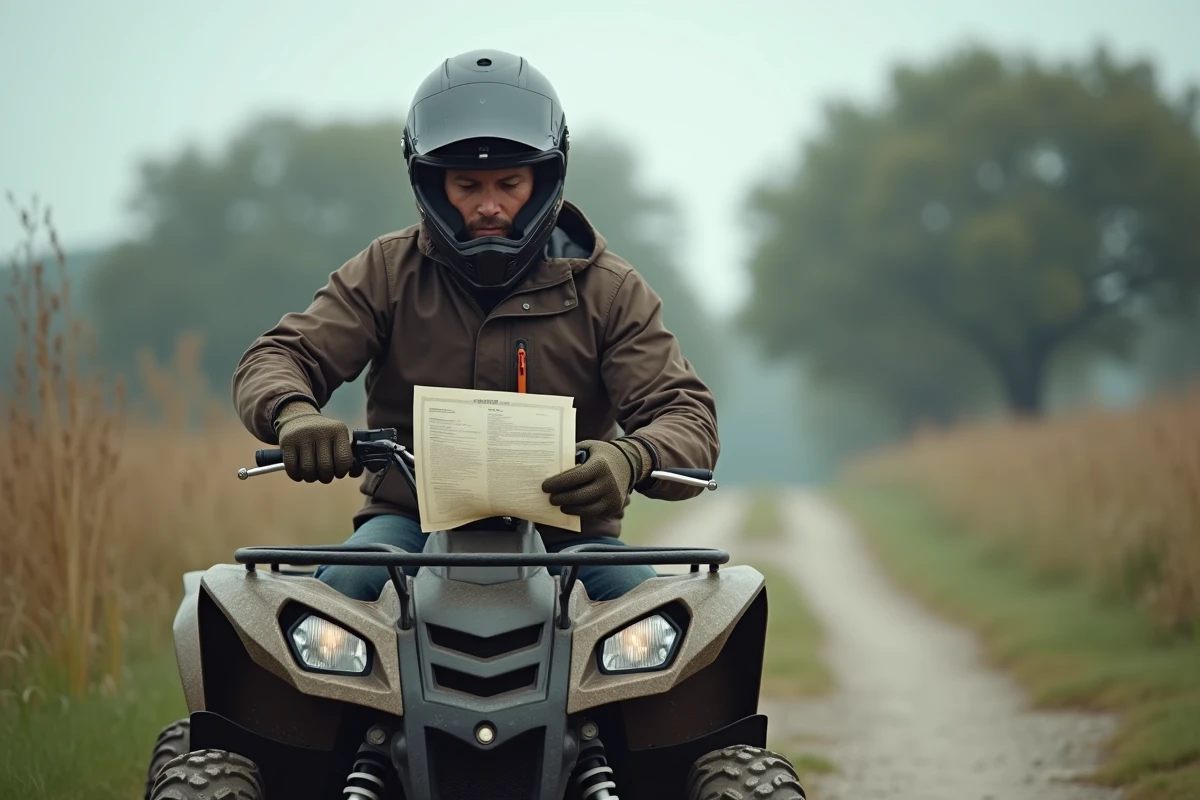
You are riding on a forest path on a quad, then you join a departmental road to head home. This simple journey raises a question that many owners overlook: does your machine have the right to travel on public roads, and with what license?
Category T3B: what this letter changes for your quad
French regulations classify motor vehicles by categories. A quad intended for the road falls into the family of L vehicles, and more specifically into the sub-category L7e-B, known as T3B. This classification designates a heavy quadricycle designed to transport passengers or drive on open roads.
In practical terms, a T3B homologated quad meets road safety requirements: complete lighting (low beams, turn signals, brake light), mirrors, license plate, and sometimes an advanced braking system like ABS or EPS depending on the manufacturer.
Without this homologation, a quad remains an all-terrain vehicle. It can only travel on private land. The distinction is clear: no T3B homologation, no road. Understanding the rules related to T3B homologation and quad licenses avoids surprises during a roadside check.

What license is needed to drive a road-homologated quad
The answer depends on the engine size and power of the quad, as well as your date of birth.
Light quad or heavy quad: two distinct situations
A light quadricycle (category L6e, limited in speed and engine size) can be driven from the age of 14 with an AM license. This is not a T3B quad.
A heavy quad homologated T3B requires a more comprehensive license. A B license is sufficient to drive a T3B quad if you obtained it after January 1, 2013, as the training already includes the corresponding category. For B licenses issued before this date, additional practical training of a few hours may be required depending on the case.
License A and its variations
Holders of an A, A1, or A2 license can also operate a T3B quad. The logic is simple: these licenses cover motor vehicles in category L, which includes heavy quadricycles.
- B license: access to T3B quad, with possible additional training depending on the issuance date
- A2 license: direct access, suitable for drivers already trained on motorized two-wheelers
- AM license: reserved for light quadricycles, not for T3B quads
- No license: prohibited on public roads, even for a short trip
Registration and insurance: often forgotten obligations
Having the right license is not enough. A T3B quad must be registered with the ANTS, just like any road vehicle. The registration certificate mentions category L7e, confirming road homologation.
Liability insurance is mandatory. Many quad owners used for leisure think their home insurance covers damages. This is not the case once the quad is on public roads.
An unregistered or uninsured quad on the road exposes its driver to a fine and vehicle impoundment. Wearing a certified helmet remains mandatory for the driver and any passenger.
Choosing a T3B quad: safety criteria and budget
If you are considering purchasing a road-homologated quad, several points deserve your attention beyond the displayed price.
Active safety and braking
Manufacturers like Kymco (with its MXU range) offer T3B quads equipped with assisted braking systems. ABS or EPS steering improves road handling on asphalt, an environment for which quads are not always optimized.
Also check for the presence of a lockable rear differential. On wet roads, this feature radically changes the vehicle’s behavior.
Real budget of a homologated quad
The purchase price is only part of the budget. Add registration, annual insurance, maintenance (oil changes, road tires, brake pads), and the technical inspection now applicable to certain vehicle categories.
- A new T3B homologated quad costs significantly more than a non-homologated all-terrain model
- Road quad insurance is higher than simple leisure insurance
- Mixed or road tires wear out faster on asphalt than in off-road use

Tips for riding a T3B quad daily
A T3B quad remains an atypical vehicle on the road. Its width, high center of gravity, and lack of closed bodywork require adapted driving.
Maintain a greater safety distance than in a car. The braking distance of a quad, even equipped with ABS, requires more distance than that of a sedan.
Ride with protective gear: full-face helmet, gloves, high boots, and abrasion-resistant clothing. Unlike an SSV, the quad has no protective structure in case of a side impact.
Visibility is another point to watch. Drivers often do not anticipate the presence of a quad in traffic. A high-visibility vest and well-adjusted lights reduce this risk, especially in low light conditions or during rain.
T3B homologation opens the road to quads, but it also commits the driver to respect the same rules as all other users. A valid license, proper registration, active insurance, and suitable equipment form an inseparable set for legal riding.