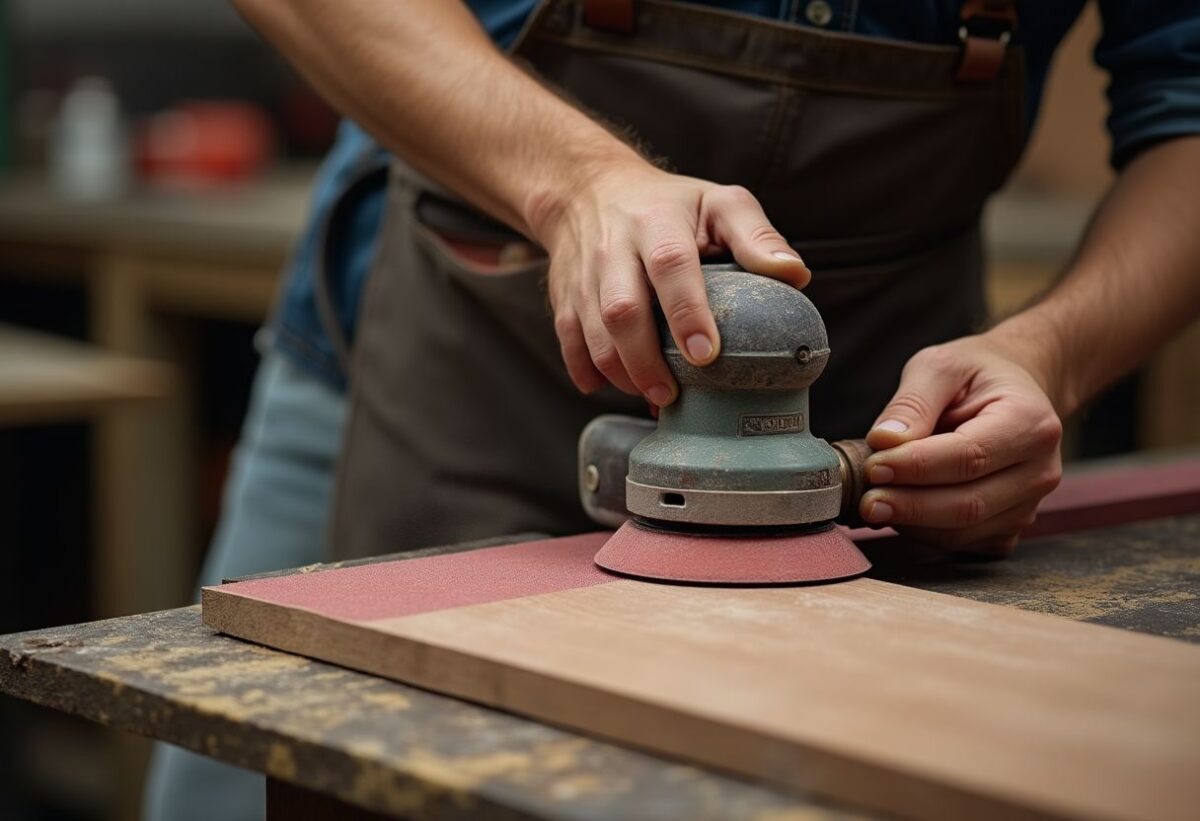
The sanding belt is an essential tool in the field of material work, whether it involves wood, metal, or even stone. In the vast universe of sanding and finishing tools, it stands out for its ability to combine efficiency and precision. Whether you are a seasoned craftsman or a passionate DIY enthusiast, understanding the operation and applications of this tool is crucial for achieving impeccable results. The sanding belt consists of a cloth or paper impregnated with abrasive grains, glued to its surface. It is used for grinding, polishing, and smoothing various materials, and it is inserted into specific machines called belt sanders. But why such popularity? What are the specific features and advantages that make this tool indispensable in the workshop?
Origin and evolution of sanding belts
The history of the sanding belt dates back several centuries, with significant developments over time. From the earliest civilizations, humanity has used natural objects for abrading and polishing. Innovation has allowed for the refinement of these tools, leading to the modern sanding belt.
The first sanding belts were made from natural materials like sand and shells. Over the centuries, technology has progressed, enabling the development of new synthetic materials. This evolution has resulted in more durable and efficient products.
- Natural materials: Use of stones and sand.
- Industrial revolution: Introduction of synthetic materials.
- Continuous innovation: Advances in manufacturing techniques.
This progression has not only improved the quality of sanding belts but has also expanded their range of applications, making them indispensable in many industrial sectors today.
Operation and technical characteristics
Understanding the operation and technical characteristics of the sanding belt allows for optimized use. Each element, from the grain to the backing, plays a specific role.
Sanding belts consist of three main components: the backing, the abrasive grains, and the adhesive. The backing, often made of paper or fabric, provides a base to which the abrasive grains are attached. The grains themselves are generally made from materials like aluminum oxide or silicon carbide, chosen for their ability to sand different types of surfaces. Finally, the adhesive keeps the grains in place, ensuring the durability and effectiveness of the belt.
- Backing: Influences flexibility and durability.
- Abrasive grains: Determine aggressiveness and finish.
- Adhesive: Ensures cohesion of the whole.
The selection of the appropriate sanding belt depends on these criteria, as well as the specific application for which it is intended.
Applications and advantages of sanding belts
The use of a sanding belt extends to many fields, from the woodworking industry to metallurgy, as well as automotive and DIY projects. Its effectiveness lies in its ability to adapt to different materials and provide a high-quality finish.
- Woodworking industry: Allows for fine or coarse sanding of wooden pieces, ensuring a smooth surface for finishing.
- Metallurgy: Used to remove rust, polish metal surfaces, and prepare metals before welding.
- Automotive: Essential in preparing surfaces before painting or for polishing car bodies.
- DIY: Enthusiasts use it for various renovation and creation projects.
The advantages of sanding belts lie in their versatility and efficiency. They allow for achieving a high level of finish while optimizing the time and effort required to work with materials.