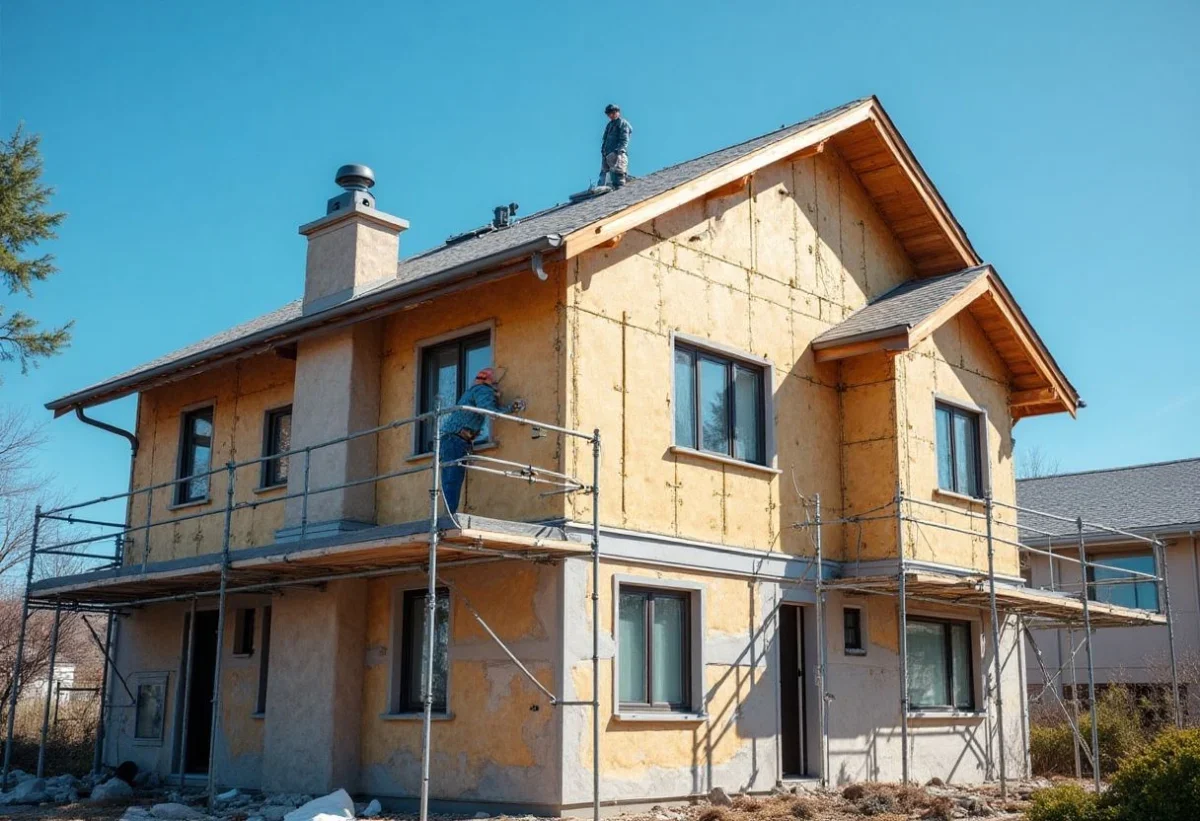
Responding to current environmental challenges requires concrete actions regarding how we design our homes. External insulation stands out as a preferred solution for improving the energy efficiency of buildings. With the approach of the year 2025, a turning point is occurring in the construction and renovation sector. This period marks an acceleration of initiatives related to energy transition. Thanks to this insulation method, it becomes possible not only to reduce thermal losses but also to enhance real estate assets while contributing to the preservation of the planet.
The energy challenges of external insulation
With global energy consumption constantly increasing, it is imperative to optimize the thermal performance of our homes. This optimization involves proven and effective techniques such as external insulation.
- Reduction of thermal losses: improving the insulating envelope of a building significantly reduces energy losses, which translates into lower heating bills.
- Improved thermal comfort: this method ensures a stable and uniform indoor temperature, with no notable variation between seasons.
- Environmental impact: less energy consumed means a reduced carbon footprint, actively contributing to the fight against climate change.
- Real estate enhancement: a property improved by quality insulation sees its market value increase, which is an asset when reselling.
Financial aid for external insulation in 2025
In light of the sometimes prohibitive costs of external insulation work, several aid schemes have been established to encourage homeowners to take the plunge.
In 2025, the government and certain local authorities are strengthening their financial support through various aids. Among these are tax credits for energy transition and specific grants for thermal renovations. The zero-interest loan, which facilitates the financing of work without interest, is another advantageous option. Additionally, aids such as the zero-interest Eco-loan are aimed at modest households, allowing them to access renovation solutions without straining their budget.
Innovative techniques for external insulation
The construction sector continues to innovate to offer increasingly efficient and environmentally friendly materials and processes.
Insulating materials are constantly evolving, providing ever-higher performance. The use of bio-based materials, such as hemp or cellulose wadding, is gaining popularity. These materials, in addition to being effective, are also sustainable and renewable. Vacuum-insulated panels, although more expensive, offer unmatched performance due to their low thickness. Furthermore, they allow for better space management in constructions. Finally, the integration of aesthetic finishes directly onto insulation systems offers homeowners the opportunity to personalize the exterior appearance of their homes.
The benefits of external insulation aid 2025
To encourage more households to engage in these renovation works, the integration of external insulation aid 2025 plays a determining role.
The incentives offered are not limited to simple financial support. They also include technical assistance to guide homeowners through the stages of their projects. Preliminary energy diagnostics are often provided, allowing for precise targeting of improvement needs. Training and workshops on eco-responsible practices are also set up to raise awareness and inform the public. Finally, the creation of labels and certifications ensures the quality of the work carried out, thus providing additional long-term satisfaction guarantees.
Adopting external insulation in 2025 represents much more than a simple improvement of the habitat; it is a commitment to a sustainable future. By benefiting from the available aids, homeowners can not only optimize the comfort of their homes but also actively contribute to environmental protection.